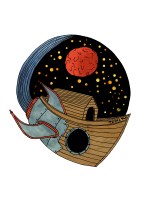
Heart Matters.
We have not met. We never will. But I know you. I am your past. You are my future, and my hope that humanity does not end. Not yet.
There is a symbol in my time, an emblem of love, emotion, sexuality, and life. It is dismissed at times, because although it is called a heart, it looks nothing like an actual heart with its chambers and valves and veins. But this icon precedes its usage in my time, in the same way that this message precedes you. You see, there was a plant once, in the classical era, extinct centuries before my time and millennia before yours. The reason that this seemingly irrelevant herb has remained synonymous with love so long after its disappearance is simple: it was a prized contraceptive of the ancient world. Its name was silphium.
Silphium came from Cyrenaica, which in my time was called Libya. This ancient land was one of the greatest intellectual and artistic centres, famous for its medical schools, academies, and architecture. Although the area produced a multitude of goods, it was renowned for being the only area where silphium grew natively. The herb was used in cooking, as well as for a variety of medicinal purposes such as treating coughs, sore throat, fever, and indigestion. However most intriguing was its use as a contraceptive. What better a symbol for love than a commodity that allows for birth-control?
In fact, it was connected to passion and sexuality to such a degree, that Gaius Valerius Catullus, a Roman composer of love poems wrote about it to his lover, over two thousand years ago. I thought you might like it.
How many of your kisses are enough and more than enough for me.
As big a number as the Libyan grains of sand that lie at silphium producing Cyrene.
Such a product must have had great significance, as the human condition with regards to love and contraception is, in a way, a predicament. On the one hand, sexuality is an indispensable need for many people. But some kinds of contact can lead to reproduction, whether intended or not. This underlying principle not only leads to a whole new level of responsibility, regardless of a person’s ability to cope, but is also particularly gendered. The burden and the dangers involved with pregnancy fall, to a large degree, on women. You can see then how a way to love without fear was valuable, as well as liberating.
Pliny the Elder, another Roman author before my own time, wrote that the value of silphium was such, that it was recorded as being sold at the same rate as silver. It was so popular and widespread, that coins depicting the pod survive to my day. In this capsule you will find enclosed one of these coins, merely a replica I bought for you from the museum shop. Look at it; the silphium pod is identical to the heart ideogram.
Soon though, our greed and short-sightedness caught up with the environment’s ability to cope. I thought that would interest you. Is that not why you too left Earth? Silphium was not particularly suitable to domestication and Pliny wrote that it was,
In general wild and stubborn… if attempted to be cultivated, will leave the spot where it has been sown quite desolate and barren.
That is quite like us, is it not? Wild and stubborn. You cannot forcefully cultivate us lest we too leave our environment and ourselves desolate and barren.
After overconsumption by humans and overgrazing by livestock, combined with the desertification of the land, silphium disappeared from Cyrenaica. My research found traces of it elsewhere, in Persis, Media, and Armenia, although in much inferior quality and even these instances eventually dwindle, so in the centuries following the collapse of the Roman Empire silphium came to be considered altogether extinct. We are making again the mistakes of the past in my time. Consumerist greed, climate change, commercialisation. It was our choices that forced you away from your home.
But humans find hope even in the darkest places. There has been a rediscovery in my time, of a plant named silfer, genealogically related to the extinct species. It is not the same, just like your colony is not the same as Earth. But we are nothing if not stubborn. If an incarnation of silphium has been found again, then we can still dream of recovery and hope for a future in other things. A new home for us among the stars.
I tell you this because I too want to hope that the symbol we use to say ‘I love you’ is not forever gone.
Sincerely,
C. K.
Terra One
P. S. Find enclosed in this capsule a preserved sample of silfer, in the hope that this story that we share now, you and I, lives on through you.
Caesar Kommatas studied English Literature in York St John University as an undergraduate following a distinction in York College’s Humanities course. He recently completed a Master’s degree in Contemporary Literature and is currently expanding his corpus of fiction set in the space fantasy mythos that he has cultivated over several years.
 Terra Two