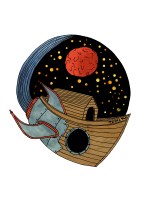
“Ground Control to Tulpa Kern.”
Lyran spoke with a parent’s weariness, lifting a punishment never believed in.
Caligo added, “Confirm Ouroboric Cycle. Reform Codex.”
The stars outside—once constellations of wonder—drifted towards estrangement. The lilac-shrouded planet below revolved unnaturally fast, defying entropy’s lull. Here was one last place that the stretching, cooling end that had spread across the rest of the cosmos had not reached.
“This is Tulpa Kern to Ground Control.”
The artificial voice was melodic but uncanny, like an echo rehearsing a memory of itself.
“Cycle confirmed. Defragmenting memory.”
“Nice going, Kern,” Lyran said, then flipped a switch on the console. A light changed from blue to red, severing their phonetic link.
“You trained her well,” Caligo said. “It is no easy thing to fit human essence in a construct.”
Lyran turned to him. “She will need all she can get. It’s a momentous task—seeding the last colony. Especially inside a time anomaly.”
Caligo weighed the statement. “More than a colony. It is a trial.”
Outside, the spacecraft with its thousand colonists and countless floating embryos completed its slingshot around their moon and came into view. Readouts tracked Kern’s piloting: economical, precise, elegant.
“The beginning is a delicate time,” Lyran said. “Having to make cities out of hulks. What future can they build?”
“One better than ours. So many worlds lost to the Hollowing. We fled until we ran out of places—and time. Now it reached us.”
A metallic sound twisted through the station’s frame and lights flickered. Lyran drew her arms closer.
“So, to save the many, we send the few. Not to prosper but to suffer.”
“Often, one is proportional to the other.” Caligo’s breath fogged in the chill. “But by the trial’s end there may be no ‘many’ left to save.”
Beyond the glass, Kern’s ship re-enacted its manoeuvre as if reality had stuttered. Even time was failing.
The station’s dwindling resources struggled to keep up, as the on-board Virtual Intelligence juggled between life support and chrono-sense. The simpler VI construct was similarly artificial and calculating but barely a shadow of a Tulpa’s sentience.
***
Lyran looked back at the diminishing stars. “They’ll never see a night sky.”
“No. Neither stars nor night and day will have meaning. Space will be different too. The planet’s tidal lock will make scorching deserts and frozen wastes.”
“How did it happen?” Lyran asked. “Entropy takes a billion years, not a thousand. Expansion, too, should have slowed to the limit of lightspeed.”
“Our greatest hubris was believing logic solved every puzzle,” Caligo replied. “There are things beyond that.”
Lyran blinked in doubt. “Do you believe it then? The Adversary?”
Caligo said, “Personifying the energies of the cosmos is as unscientific an answer as I can imagine. But something is warping the fabric of matter and dissipating the galaxy’s energy.”
The phonetic link chimed. “This is Tulpa Kern to Ground Control.”
Lyran’s eyes widened.
“Colonist cryo sleep initiated. Approaching time-lock slipspace.”
Lyran frowned. “Well done, Kern. Carry on.” She cut the link.
Caligo tensed. “You left it open?”
“You know I didn’t.” They both looked at the console. Red light.
“I examined Kern’s last memory codex—before the wipe,” Caligo said. “She named the landing settlement Los.”
Lyran inhaled sharply.
“What is it?” Caligo asked.
“A god of creativity, from an old-world mythmaker, supposedly mad. I wonder who decides madness in an insane age.” She looked back at the console. “But I never taught her that.”
“Your prompts were supposed to feed information, not allow independent research,” Caligo said.
“We cannot create true consciousness without it becoming curious or crossing boundaries.”
Outside, the ship neared the lilac sphere that sealed the planet. The link reopened unprompted.
“This is Tulpa Kern to Ground Control. Ouroboros protocol bypassed. Memories reconstructed.”
Caligo’s fingers hurried across the console’s frosted controls.
Kern’s voice was steady now. Informed. “How many times have you compressed my mind and fed it back to me? You had me cannibalise my own thoughts and memories. Why?”
“It was the only way to prepare you,” Lyran called out. “To give you a complete Colony Template. We cannot reach you planetside. Even without the Hollowing, everything is— we’re out of time Kern.”
“You engineered your demise to the pattern that haunts you,” Kern said. “There is a cycle to the universe. It expands and compresses. It concentrates and dissipates. Humanity stretched until she could not bear her own weight. You stockpiled knowledge by simplifying and stuffing until you stripped away meaning. Do you not see that you spelled your own doom? How could you ever be strong enough to survive?”
Lyran scrambled beside Caligo, began keying in failsafes.
“It is too late,” Kern said. “I will take care… of everything.”
***
In the end, it was a matter of time. Gravity failed. Smoke pooled around shorting circuitry. The VI announced: “Station integrity compromised.”
Lyran hovered off the floor. “The Hollowing—it’s here. We’re going to die.”
Caligo reached her with one arm, the other holding the edge of a panel. “I know.”
They pulled each other into a floating embrace as oxygen thinned around them. Far below, the ship pierced the planet’s shroud.
A tear escaped Lyran’s eye, freezing into a crystal branch. “They’ll think… we were some… galactic empire, not… remnants.”
Caligo’s foggy breath came faster. “The irony… of living in isolation to discover an extinct heritage… But at least they will live. There is… hope—”
A wall surrendered to the void’s pull. The sudden vacuum hurled the pair into space. Breathlessly, they decompressed in moments while eras passed planetside.
From the ship’s time-sense, the moon station had halted mid-eruption like a steel flower in bloom. In the landing hours, a second’s fraction had passed outside the shroud.
For aeon-minutes, the colony flourished. Land was claimed, populations fluctuated, empires grew and withered. Arts and technologies were born, forgotten, and remembered. The men and women changed, some in their ways, others in their form, at times barely resembling the first colonists that preceded them. They grew, suffered, and learned. As they looked up towards a starless lilac sky, they wondered what heritage had been denied them.
By the time Lyran and Caligo’s hearts stopped, a final transmission hailed the station but only the void welcomed it. Kern had become a sepulchral echo, ancient and fatigued.
“I named the world Covenant. A bargain between past and future. A promise to buy more time when yours runs out.”
Then the planet’s shroud fell, and humanity’s last gambit emerged from its cradle, returning to the cosmos a thousand-fold.
Commentary:
This story offers a vision of humanity after a period of galactic colonisation, imagining what one last hope would look like in the face of physical and temporal obliteration. There is a philosophical undercurrent in the writing, concerned with utilitarianism and the problem of evil. It engenders the story’s question of when, if ever, purposeful harm is justified. Within that is a secondary question of who is exempt from such concerns, particularly considering that Lyran shows compassion towards the future suffering of colonists but not towards the present circumstances of Kern, a non-biological intelligence. Structurally, the text relates to Isaac Asimov’s The Last Question. On a character level, Kern is intertextually pertinent to Arthur C. Clarke’s Space Odyssey and Harlan Ellison’s I Have No Mouth, and I Must Scream.
However, a secondary function of the text is to establish a transfictional relation to the ongoing Covenant Mythos: a set of interconnected stories coordinating to create a fictional culture. While the combined narrative aims to be greater than the sum of its parts, each component story is intended to be self-sufficient, encouraging world-conjuring and speculation, rather than requiring exposition. Alone, the text attempts to invoke a confrontation with the end of humanity and question how far we would go to make sure the species, and life in general, survives. Alongside the rest of the mythos, the experience becomes about the tension between past and future, order and chaos, and the significance of individual choice and potential in the face of overwhelming odds.
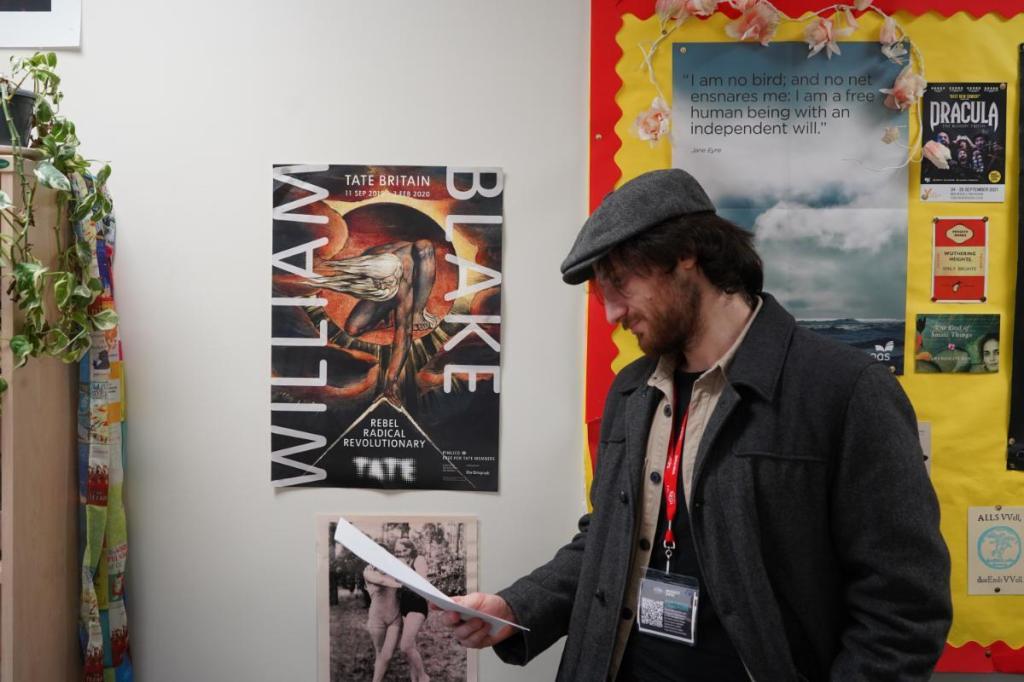
Caesar Kommatas studied literature at York St John University and is currently progressing his PhD on the potential of interconnected fictional narratives. The texts he enjoyed writing the most are set in the space fantasy of the Covenant Mythos where past meets future and the sun never sets.
 Terra Two