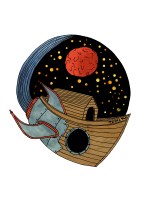
Time is a tool used to reframe one’s perspective of pain and loss in Denis Villeneuve’s Arrival and Ted Chiang’s Story of Your Life, with both texts exploring possible methods of recontextualising time and coping with the existence of pain. By changing the way in which Louise Banks, the protagonist of these stories, understands and perceives time, she is forced to reconcile with events of her life that have yet to pass—and, in doing so, change her perspective on grief and the value it brings to life. This shift in perspective is portrayed as a kind of enlightenment brought on by not just contact with an alien species, but with the sustained and meaningful effort to understand them.
The theme of enlightenment in Arrival is made especially prevalent by the imagery of the Heptapods’ written language, presented in the form of a gaseous substance produced by the Heptapods that separates into three points before joining to form an ink-like circle (Arrival 36:43–36:51) resembling a symbol of Zen Buddhism known as an ensō. The ensō is described by Dietrich Seckel and Andreas Leisinger as ‘a simple, empty circle [that] symbolizes the highest level of Zen insight’ (82)—an image of enlightenment. Just as each circle written by the Heptapods conveys a new meaning based on its deviations, so too is an ensō made meaningful by its irregularities; as described by Sonia Contera, ‘[e]ach enso is different; it reflects the body and soul of the calligrapher, but also the hearts and minds of those who view it in that particular instant. It links space, time, human perception, technology, and action; it represents enlightenment, truth, the entirety of the universe’ (185). It is a versatile symbol, often used in meditative practices in order to help one’s mind grow closer to true enlightenment by repeatedly drawing it in single-strokes, all of which can be compared to Louise’s reaction to the logograms she studies. They are not only a form of expression for the Heptapods, but a tool and a gift they intend to give to humanity, if humanity can only understand it. The more Louise comes to comprehend their language, the more her mind changes, seeing the truth of the Heptapods’ presence on Earth and what they offer. The Heptapods’ written language is, as Ian explains, ‘free of time. Like their ship, or their bodies, their written language has no forward or backward direction’ (Arrival 52:51–53:02), due to its circular form. The three points of gas that merge to form each logogram could potentially represent the past, present and future melding into one continuous cycle, no point in time privileged over another in a Heptapod’s mind: this is how Louise comes to perceive the universe, too.
In Story of Your Life, Louise describes how ‘[b]efore I learned how to think in Heptapod B, my memories grew like a column of cigarette ash, laid down by the infinitesimal sliver of combustion that was my consciousness, marking the sequential present’ (Chiang 166), presenting sequential time as a kind of decay, with the past being metaphorically burnt away like ash. The present moment moves further away as the future approaches, leaving the past untouchable and the future intangible. What has been known can no longer be felt, and what is to come cannot be known. Only the present can be influenced. This kind of thinking is defined by Steven Hales and Timothy Johnson as ‘[e]ndurantism … [:]the view that objects have three spatial dimensions and move through time … An object that is here now is entirely here now, and only here now’ (524) and it is the most common understanding of time for humanity—sequential existence. However, ‘after [Louise] learned Heptapod B, new memories fell into place like gigantic blocks, each one measuring years in duration, and though they didn’t arrive in order or land contiguously, they soon composed a period of five decades’ (Chiang 167) the past, present and future no longer existing separately but through imagery of physical objects ‘like gigantic blocks’ that fit together to create a whole. This concept of time no longer fits the definition of endurantism, but rather aligns more closely with ‘perdurantism … the denial of endurantism’, a theory of time in which ‘objects are not wholly present at each time at which they exist … When we see an object here and now, we are seeing the parts of it that are now – but there are other parts of it at other times that we might have encountered or might yet encounter’ (Hales and Johnson 525) such as the difference between the Louise still deciphering Heptapod B and the Louise grieving her daughter and marriage. There is no point in time privileged over another in a Heptapod’s mind; this is how Louise comes to perceive the universe, too.
Louise Banks is a character that leads with curiosity, an open mind and the readiness to take risks in her attempt to connect with and understand the foreign and new. She is enlightened by this understanding, not in an act of grand transcendence of time and space, but in a way that provides new meaning and value to her life and the lives beyond her own. Time, nature, existence and language are an interconnected weave, and finding her place within that web allowed her a greater perspective of the universe. These stories are not necessarily asking an audience to consider themselves in four dimensions or to perceive time simultaneously, as the Heptapods do: rather, they show how, through sustained and genuine effort to understand new knowledge, a person’s worldview can dramatically shift. Arrival and Story of Your Life are about connection with the alien and the uncomfortable—they are about coexistence. Pain and joy, future and past, freedom and inevitability. These are not paradoxical concepts, but companions.
Voyagers, should you encounter something strange and frightening out there, remember: knowledge is a tool, not a weapon, and connection is the gift of understanding.
Chiang, Ted. Stories of Your Life and Others. Pan Macmillan, 2015. Accessed 9 January 2025.
EPILOGUE.: BIOLOGY BECOMES PHYSICS: Our Coming of Age as a Technological Species?” Nano Comes to Life: How Nanotechnology Is Transforming Medicine and the Future of Biology, by Sonia Contera, Princeton University Press, 2019, pp. 171-88. Accessed 17 December 2024.
Hales, Steven D., and Timothy A. Johnson. “Endurantism, Perdurantism and Special Relativity.” The Philosophical Quarterly, vol. 53, no. 213, 2003, pp. 524-539.
Seckel, Dietrich, and Andreas Leisinger. “Before and beyond the Image: Aniconic Symbolism in Buddhist Art.” Artibus Asiae. Supplementum, vol. 45, 2004, pp. 3–107. JSTOR, http://www.jstor.org/stable/1522713. Accessed 17 Dec. 2024.
Villeneuve, Denis, director. Arrival. 2016. Now TV, https://www.nowtv.com/gb/watch/arrival-2016-2016/A5EK6sKrAaydCVDEp2Drb.

Alice Lind-O’Mara is an undergraduate student in Creative Writing and English Literature at York St John University, due to graduate in 2026. She recently published her first poem, “While it’s in the Kiln”, in the 2025 edition of Beyond the Walls, and she was an editor of the first physical publication of the York St John Folklore Anthology.
 Terra Two