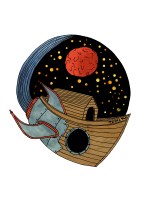
The transfer of humanity to Terra 2 gives us an opportunity to start afresh, a tabula rasa, in which we can establish a new society taking into account the learnings of our species’ past, particularly the violence and exploitation that has followed the arrival of capitalism as the dominant economic, social, and political force. Capitalism needs to be left behind if humanity is to have any chance of surviving in a truly sustainable and fair way. This includes the funding and execution of the voyage to and establishment of the first colonies on Terra 2 itself. What might this alternative philosophy be? My suggestion is that it should be an anarchist-communist one. Ursula Le Guin has already written on what an off-world society following such a philosophy might look like in her masterpiece The Dispossessed (1974), but this article is intended to explicate the moral and ethical underpinning of such a society.
It is naïve to think that the privatisation of space flight and planetary exploration led by individuals like Musk and Bezos will not also lead to the privatization of any off-world colonies which may be established using their technology. Any such privatization is not going to be innocent or utopian in nature, and it will not benefit the majority of the human race. For real world precedent, we can simply look at the legacy of the East India Company (Dalrymple 2019). For smaller scale examples of exploitation and control of their residents, we can look at company towns (Carlson 2017), towns which were built and run partially or wholly by private companies. These often held workers in restrictive communities, with rules imposed arbitrarily by the management of the company. Loss of employment in the company also entailed loss of housing and enforced displacement from the town itself. Often workers were not paid in cash, but in tokens which could only be spent in company shops at hugely inflated prices, which often kept them indentured to the company, as in the famous line “I owe my soul to the company store” from Merle Travis’ 1947 song Sixteen Tons.
Ironically enough, one of the most recent examples of what could be seen as a company town is Musk’s own imaginatively named Starbase in Texas (Robbins-Early 2025), a new town incorporated by Musk’s space company SpaceX, with a SpaceX vice-president acting as mayor. For science fiction explorations of this theme, we can look at Pohl and Kornbluth’s The Space Merchants (1953), where Earth is entirely under control of private companies, with horrendous consequences for workers. Another is Ian McDonald’s Luna series (2015), where in a commercially controlled lunar colony even the air you breathe has to be bought and paid for and if you can’t afford it, you are left to suffocate and die and your body is recycled to pay off your debt. The Terra 2 colony, on an as-yet unspecified planet, with unknown resources, cannot afford to allow this mercantile philosophy to poison the colony from the start, so an alternative philosophy which rejects the primacy of capitalism and privatisation of resources is needed.
For a philosophical rejection of the right of a private company to establish a new capitalist settlement on a new planet, we can look to the Lockean proviso, which states that private property is morally allowable only if “there was still enough, and as good left, and more than the yet unprovided could use”. We know that this is realistically not possible. Locke was writing in the 1600s, when there was no concept of the limitations of the world’s resources, when there were still vast areas of the planet left unexplored, when there was no concept that the world’s natural resources and its capacity to sustain human life were so finite and fragile. Knowing what we know now, there is no moral way in which any form of private property, or property which is not held in common for the good of all, can be justified according to the Lockean Proviso (Spafford 2023).
People may protest that this invites the ‘tragedy of the commons’ on Terra 2, but the tragedy is not that of the commons itself, but that of the unmanaged commons. The tragedy of the commons only holds if the commonly held resource can be exploited for private gain without regard to the continued sustainability of the commonly held resource. In other words, the motivation is there to maximise individual profits (in the short term), as the costs are shared. However, it has been shown that even within capitalist systems, it is not impossible to sustainably manage common-pool resources of this type (Ostrom 1990). It is also the case that if the products of the commons are returned to communal holdings, the motivation to over-exploit the commons is no longer there. Not holding private property does not preclude us from managing commonly held resources for the good of the collective as a whole.
In order to sustain such a society, all hierarchies carried over from Earth must be left at the airlock door. From a practical point of view, it is unknown what sort of challenges the first colonists will face on Terra 2. Whatever these challenges are, it is unlikely that a rigid social structure developed on Earth for specifically Earth-bound concerns and contexts will be useful. Sheri S. Tepper’s Grass (1989) is a science fiction example of a new human colony in which the old class-based hierarchies prove far more damaging than useful in their new context. Structural hierarchies are inflexible, unequal power relations which maintain exploitative relations between individuals in society who become subordinated to the capitalist state (Valliere 2025). In a society with no capitalism, with no private property, and with equality as a founding principle, institutionalised hierarchies have no place.
In sum, then, the politics of Terra 2, to ensure that humanity’s new home is sustainable and looked after in a way which we have failed to do so for Earth, must be anarchist-communist. It is only by holding all in common, treating each other with respect and in equality, that a fair and sustainable society can be established. This piece offers a starting point for discussing how this might be achieved.
References
Carlson, L. (2017) Company Towns of the Pacific Northwest. Washington D.C.; University of Washington Press.
Dalrymple, W. (2019) The Anarchy: The Relentless Rise of the East India Company. London: Bloomsbury Publishing.
Le Guin, U. (1974) The Dispossessed. San Francisco: Harper and Row.
McDonald, I. (2015) Luna: New Moon. London: Gollancz.
Ostrom, E. (1990) Governing the Commons: The Evolution of Institutions for Collective Action. Cambridge: Cambridge University Press.
Pohl, F. and Kornbluth, C.M. (1953/2003) The Space Merchants. London: Gollancz.
Robbins-Early, N. (2025) Elon Musk’s company town: SpaceX employees vote to create ‘Starbase’. The Guardian 4 May 2025. Accessible at https://www.theguardian.com/technology/2025/may/03/elon-musk-spacex-texas
Spafford, J. (2023) Social Anarchism and the Rejection of Moral Tyranny. Cambridge: Cambridge University Press.
Tepper, S.S. (1989) Grass. London: Gollancz.
Travis, M. (ND) Sixteen Tons. Accessible at https://youtu.be/5pfVvqLM_e4?si=PtzycnK7QqDIBTvF
Valliere, W. (2025) Hierarchy and Anarchy. Unpublished PhD thesis, University of Guelph. Accessible at https://theanarchistlibrary.org/library/rwilliam-valliere-hierarchy-and-anarchy#toc58
Dai O’Brien is an Associate Professor of BSL and Deaf Studies in York St John University. He is interested in radical Left politics and is a big fan of the way in which science fiction and fantasy can explore big ideas without seeming to.
 Terra Two