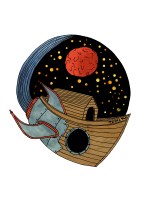
A Mariological Reading of the Maternity of Lilith Iyapo in Octavia E. Butler’s Dawn.
The plot of Dawn centres on protagonist Lilith Iyapo’s experience of the aftermath of an apocalyptic event which has rendered Earth uninhabitable, and her reluctant assimilation into the culture of her rescuers, an alien race named the Oankali. This reality is made further existentially challenging when Lilith is tasked with parenting the generation who will return to the damaged planet, a half human, half Oankali race. Motherhood is an essential theme of the novel. Butler positions maternity, significantly black maternity, as the key to survival and the resurrection of Earth. Lilith’s role as mother of this new world merits comparison to the most iconic symbol of maternity in the western world: the Virgin Mary.
Butler characterizes Lilith as the best of the surviving humans, just as Christianity, most notably Catholicism, venerates Mary as the greatest example of her sex. The “signals Mary transmits about purity, female strength and compassion” are akin to the qualities which prompt the Oankali to choose Lilith as parent of the new world (Heartney, 3). Her nature is infinitely incorruptible: she wields power without wanting it and her immediate impulse is to care. This instinct is exemplified by her response to the Oankali’s experiment placing Sharad, a young boy, in the care of Lilith in her cell, which she views as “a blessing” (Butler, 9).
Immaculate conception is Lilith’s strongest link to Mary. The Oankali see Lilith as free from “original genetic sin” because she is not instinctively hierarchical (Lennard, 88). Lilith’s two hundred and fifty years of sleep can be read as a period of enforced celibacy, a reversion to virginity so that when she is “[a]live… again” she is pure, and open to configuration by Oankali design (Butler, 3). At the novel’s end, the ooloi Nikanj tells Lilith that it has impregnated her with the deceased Joseph’s seed, and that she will bear a half human, half Oankali child. Lilith reacts with fear and revulsion: “She stared down at her own body in horror. “It’s inside me, and it isn’t human!”” (Butler, 281). Mary was similarly afraid upon receiving the news that she would bear the son of God: “she was troubled at his saying” (Luke 1:29). On a bodily level both pregnancies have an ambiguous interiority. Sex in the traditional, commonly understood sense has not happened so it is unclear how conception has occurred, how the foetus will develop, and which parent’s influence will prevail.
In some Catholic cultures, Mary has come to symbolize “ethnic pride and postcolonial resistance” (Heartney, 7). The Marian apparition of the Virgin of Guadelupe exemplifies this defiance. Mary is said to have appeared in the guise of a mixed-race woman to a peasant in the sixteenth century, and this vision is often depicted as dark skinned. Octavia E. Butler wrote that she experienced an “unhappy tension between being a science fiction writer and being a black writer”, maintaining that “she wrote SF precisely to escape the world of race and gender oppression she saw around her” (Canavan, 28). Though it is a feature of the novel that Butler was reluctant to emphasize, Lilith as a protagonist of science fiction is inescapably subversive in a genre chiefly populated and popularized by heteronormative white men.
In Dawn black maternity equates to survival. The novel “figur[es] black female production as essential, rather than ancillary or antithetical to the project of human development” (Mann, 62). Lilith’s “desire to live” and her choice to preserve the family is that of a post-apocalyptic woman, made not freely but because the alternative is intolerable (Butler, 26). Lilith is asked to parent this future without ever experiencing the fruits of her labour: “Your children will know us, Lilith. You never will” (Butler, 125). Her narrative is repeatedly sacrificial; like Mary, she acts as an “embodiment of passivity and standard bearer for resistance” simultaneously (Heartney, 7).
The Oankali’s veneration of maternal qualities prompts consideration of how a patriarchal human society dismisses them. Dawn is a novel concerned with the reconstruction of an entire world, but at the heart of the narrative lies the quiet, gradual, most essential facet of survival: a pregnant woman.
Those moving off-world would benefit from remembering Butler’s teachings: that a reliance on intrinsic processes which heed natural cycles holds the key to success, much more so than destructive and instantaneous approaches.
Works Cited
Butler, Octavia E. Dawn, 3rd edition, Headline Publishing Group, 2022.
Canavan, Gerry. “CHILDFINDER (1947–1971).” Octavia E. Butler, University of Illinois Press, 2016, pp. 13–29. JSTOR, http://www.jstor.org/stable/10.5406/j.ctt1hfr05s.7. Accessed 3 Jan. 2024.
Heartney, Eleanor. “Thinking through the Body: Women Artists and the Catholic Imagination.” Hypatia, vol. 18, no. 4, 2003, pp. 3–22. JSTOR, http://www.jstor.org/stable/3810972. Accessed 3 Jan. 2024.
King James Bible. Luke 1:28- 1:33. 1611.
Lennard, John. Octavia Butler : Xenogenesis, edited by John Lennard, Humanities-Ebooks, LLP, 2007. ProQuest Ebook Central, https://ebookcentral.proquest.com/lib/yorksj/detail.action?docID=3306062.
Mann, Justin Louis. “Pessimistic futurism: Survival and reproduction in Octavia Butler’s Dawn”, Feminist Theory, Vol. 19 No. 1 (2018) pp. 61-76.

Erin Blaney is a writer from Derby living and studying in York. She is the editor of The Eighth zine”.
 Terra Two