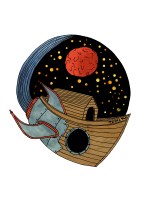
Dear Future Kin,
You may wonder how I had the nerve even to consider that you would need my advice, let alone pick up my iPad and write this message to you. I suppose it was done out of a desire for a morsel of absolution.
I don’t know where you are now, as you read this. One can only assume you are already on TerraTwo and have begun to tentatively call it ‘home’. You are probably in the early stages of terraforming or at least seriously contemplating it. Whatever stage you are at, I must say one thing: listen to the plants!
Before the Great Decline, humans once lived in kinship with plant life. We interacted with flora in mutual and sustainable ways. Plants were revered not just for their medicinal uses, but also for their spiritual and magical presence. Each plant was known, respected, and collaborated with.
But in what we once called ‘the West’, primarily European cultures, we became entranced by religions that sought to control, to dominate, to judge. These faiths elevated male humans above all others, particularly women and other-than-humans. Men of wealth and science came to see themselves as the chosen, the only vessels for the words of omnipresent gods. Through them, authority became law, and these laws became embedded into the very way people thought and lived. Those outside this structure, the ‘Others’, were silenced. Their knowledge was dismissed, reduced to folklore and children’s tales.
And yet, something remained. A whisper and an echo. What they couldn’t erase was the ancestral memory still inside us, as of yet, unproven, ineffable, but present. We had a word for these echoes: enchantment. A feeling that something larger than us exists, both tangible yet distant, something powerful that we sense but cannot name. Some of us found enchantment in the constellations, others in Luna or the planet Venus. But for the purpose of this letter, I want to speak of the plants, and how some of us remembered to listen to them and sought to treat them as kin and equals.
As we tried to rekindle our relationship with plant life, we developed phrases and frameworks to describe this return. Words like trans-species listening, thing-power, philosophical animism, vitality, and posthuman kinship emerged to capture what is, at its heart, a simple truth: that humans live in a web of entangled beings. We are shaped by and in turn shape countless others. We and the plants are companions and kin and we intra-act. And from these entanglements, new phenomena emerge.
The problem was that Western culture, and the global systems it imposed, had largely forgotten this. We forgot how to listen and we forgot how to be kin. Those of us who spoke of communication with plants were not taken seriously. After centuries of dismissal and testimonial injustice, many of us struggled even to find words for what we felt. We became mute. We became apathetic.
Yet as I write this, there are glimmers of remembrance. Western society is slowly beginning to reawaken its kinship with the plant world, albeit cloaked in academic language that renders it almost inaccessible. Somehow, if this kinship is expressed in complex terminology, it becomes more acceptable, more believable.
So now we hear stories being taken seriously, stories of transplanted eucalyptus trees teaching us about racial difference, of an oak tree offering a reader a place of rest, of an ingested plant reshaping the human through its agency. And here I offer some of my own.
I have heard tales of oak trees who embody the spirit of the Father of the Wood, and lime trees who hold the essence of the Mother. I have been told of mischievous nettles who lash out with a sting no matter how wide a berth you give them, and of a stand of poppies on a pesticide-scorched field margin who whispered stories of perseverance. I was told a tale of a cup of chamomile tea that bloomed into the image of a blonde woman dancing in golden corn and a lavender plant who invoked memories of a mother. I’ve heard a wall of poplars warn of an approaching storm, and a sage plant insist on being moved, even though it meant certain death over winter. I’ve worked with dried chickweed who urged it could heal a wound, and heard of a rosemary bush who called out to the weary, offering revitalisation.
So, why does this matter? Why listen to plants? Why treat them as kin?
I hope, somewhere in your TerraTwo ark, you come across another offering of mine, one that explores the writings of a human named Val Plumwood. Her work delved into the concept of dualisms, a system of oppositional thinking that divides the world into binaries: male/female, nature/culture, human/non-human. These binaries rely on domination, with one side valued and the other subordinated. They lie at the heart of many of Terra’s modern crises. When we see the other-than-human world as merely a collection of objects to be used and consumed, the planet ceases to be a home to others. It becomes a resource, something to exploit, reshape, or discard. This mindset brought us to collapse.
This is why I write to you now. To implore you to listen. Listen to the plants. Listen to all the entities that form your new worlds. See yourself not as separate from them, but as part of an entangled web of kinship. Let this guide your choices. Let this shape your ways of being. Do not repeat our mistakes.
The ALTHEA Code of Ethics for the Terraforming of TerraTwo
We, the first generation to settle a world beyond Terra, recognise that to shape a planet is an act of profound consequence and carries an immense burden of responsibility. The code of ethics below is referred to as ALTHEA (A Living Treaty for Harmonious Ecological Alteration) and we will seek to adhere to it’s principles for all our actions. Working within this framework and enabling it to guide our every action, we can ensure that our terraforming activities are grounded not in pursuit of dominion, but in kinship, care, and vital entanglement. The guiding principles of ALTHEA are such:
1. Ignorance is not an excuse.
We will not act without first understanding or trying to understand.
All interventions must follow periods of deep observation and reflection.
We will not assume that barren equals emptiness.
2. Treat the planet as kin and not a project.
This world is not dead, but an entity with its own rhythms and memory.
We will listen to its silences, respect its storms, and honour its stillness.
Our terraforming will begin in conversation, not conquest.
3. Minimise extraction, maximise reciprocity.
Where we construct, this will be from native, sustainable materials.
Where we plant life, we will not usurp what was already there.
Where we build, we will unbuild if needed.
4. Terraform with restraint and reverence.
Terraforming will be slow, adaptive, and reversible where possible.
We will aim to live-with or adapt over redesigning.
We will not insist on Terra’s image, but allow new ecologies to emerge.
5. Enshrine the rights of Other-Than-Human matter.
All introduced life will be treated as collaborators, not tools.
We will advocate for the well-being of existing and emerging biomes.
The mineral and elemental have intrinsic vitality beyond just use.
6. Live lightly and temporarily
We accept our presence is experimental, not inevitable nor guaranteed.
We will build with impermanence in mind.
Our settlements will leave no scars that cannot be erased.
7. Hold space for the unknown.
We will leave parts of this world untouched.
Some regions will be declared sacred, even if barren by human standards
The mystery of the planet will not be erased by colonisation.
8. Reject replication of Terra’s dualisms.
We will not recreate hierarchies of race, class, gender, or species.
All entities will be afforded dignity.
Emergent spiritualities will coexist with science.
9. Make every action, a ritual of accountability.
We will gather regularly to reflect, mourn, celebrate, and correct.
Terraforming is not a one-time act, but a lifelong ethical practice.
Stories, songs, and silence will accompany every change we make.
10. Teach our offspring that the planet is not owned by us.
The planet and its assemblages are emancipated.
Humans will not sit in dominion or judgement over other entities.
We are learners and students of this place, not owners.
May the above code guide you and your kin during your journey on this planet. Welcome to TerraTwo and tread lightly.
The Works of Val Plumwood
This is my account of two of the most important (in my opinion, anyway) works by Val Plumwood (1939–2008), an Australian ecofeminist philosopher known for her powerful critiques of Western rationalism, anthropocentrism, and the dualisms that underpin much of Western thought. These works are Feminism and the Mastery of Nature, published in 1993, and Nature in the Active Voice, published posthumously in 2009.
I hope this brief account will encourage you to seek out the full texts, which are hopefully stored electronically somewhere in your archives. May her words and theories inspire you to develop similar ways of thinking and being on TerraTwo, enabling a more sustainable and harmonious society for all humans and other-than-humans.
In Feminism and the Mastery of Nature, Plumwood discusses and elaborates on the concept of dualism. Dualism is defined by Plumwood as “the process by which contrasting concepts (for example, masculine and feminine gender identities) are formed by domination and subordination and constructed as oppositional and exclusive” (Plumwood, 1993, p. 31). She later explains in Nature in the Active Voice that “the hyperbolised opposition between humans and the non-human order I call human/nature dualism is a western-based cultural formation going back thousands of years that sees the essentially human as part of a radically separate order of reason, mind, or consciousness, set apart from the lower order that comprises the body, the woman, the animal and the pre-human” (Plumwood, 2009, p. 116).
Major dualisms within Western thought during my lifetime in the early to mid-21st century included Culture/Nature, Reason/Emotion, Male/Female, and Mind/Body. The actual number of dualisms, however, is unquantifiable, because, as Plumwood states, any distinction in society can be treated as a dualism (Plumwood, 1993, p. 43). These dualisms can be seen as the source of contemporary human and environmental crises, and Plumwood stressed the urgency of resolving them, otherwise, we risk remaining trapped within this period of multiple crises (Plumwood, 1993, p. 6). I suspect you have laughed ironically at that last statement.
Faced with the sheer scale and entrenchment of dualisms, it often felt like an insurmountable challenge to imagine how we might break free. This is where Plumwood offered a path forward: the concept of philosophical animism, a theory and way of believing that can instruct both science and creationism to “Re-envisage materiality in richer terms that escape the spirit/matter and mind/matter dualisms involved in creationism. Forget the passive machine model and tell us more about the self-inventive and self-elaborative capacity of nature, about the intentionality of the non-human world” (Plumwood, 2009, p. 122).
Animism traditionally ascribes a living soul or spirit to animate and inanimate objects and natural phenomena. This way of being is often seen in beautiful resonance in peoples who are deeply indigenous to their landscapes, such as those from Australia and North America.
Plumwood identified herself as a philosophical animist, not someone who literally sees living souls in all matter, but someone who recognises the agency, vitality, and entanglement of all things. Other-than-human beings, such as animals, plants, rivers, and landscapes, are recognised as active, entangled participants in the world, not simply as resources or scenery. Her philosophical animism is not about believing that every rock or plant has a human-like mind, but rather about undoing the cultural habit of denying liveliness, meaning, and agency to the world beyond humans. By participating in such a framework, we can begin to engage with non-human others and Earth systems in more ethical, empathic, and sustainable ways (Plumwood, 2009). It becomes a means of challenging the dominant Western view that nature is inert, passive, and separate from humanity and culture.
As mentioned above, the Western predisposition for dualistic thinking is, in Plumwood’s view, a root cause of contemporary and environmental crises. Woman and Nature are lumped together as the “other” in opposition to Man and Culture. This is where another of Plumwood’s theories comes into play: critical ecofeminism, which I will explain as concisely as I can below.
The precursor to critical ecofeminism was ecofeminism, which held the basic premise that the ideology enabling the oppression of women was the same ideology that sanctioned and enabled the oppression of nature. Critical ecofeminism recognised this connection and went further, exploring the issues and tensions at the intersections of gender, sexuality, species, class, and race. It can be summarised as an intersectional, posthumanist framework that links environmental and social justice by exposing how systems of domination, such as patriarchy, colonialism, and speciesism, mutually reinforce one another. It challenges dualisms such as nature/culture and human/other, and emphasises embodied, relational, and affective ways of knowing. It revels in queering relationships with the other-than-human world and refuses to essentialise women as being “closer to nature.”
Thus, “critical ecological feminism can reject both the distorted choices generated by nature/culture dualism” by rejecting “the model of women and women’s reproductivity as undifferentiated nature” and “the attempt to fit them into a model of oppositional and masculinised culture” (Plumwood, 1993, p. 39). Women, therefore, do not have to be reduced to their reproductive abilities or their supposed affinity with nature. As Plumwood expresses, “If we think that the fact of being female guarantees that we are automatically provided with an ecological consciousness and can do no wrong to nature or one another, we are going to be badly disappointed” (Plumwood, 1993, p. 10).
Philosophical animism can thus be seen as one facet of critical ecofeminism, a way of subverting the nature/culture dualism. In doing so, we might begin to imagine societies where other-than-human beings are not merely treated as tools or resources, but as kin and entities in their own right. Such a mindset could help us address the vast environmental challenges we are facing. Yet the fact that I am writing this essay suggests we did not succeed. I only hope you are able to adopt this way of being on TerraTwo and avoid repeating our mistakes.
Plumwood, V., 1993. Feminism and the Mastery of Nature. London: Routledge.
Plumwood, V., 2009. Nature in the Active Voice. Australian Humanities Review, (46), p.111-127.
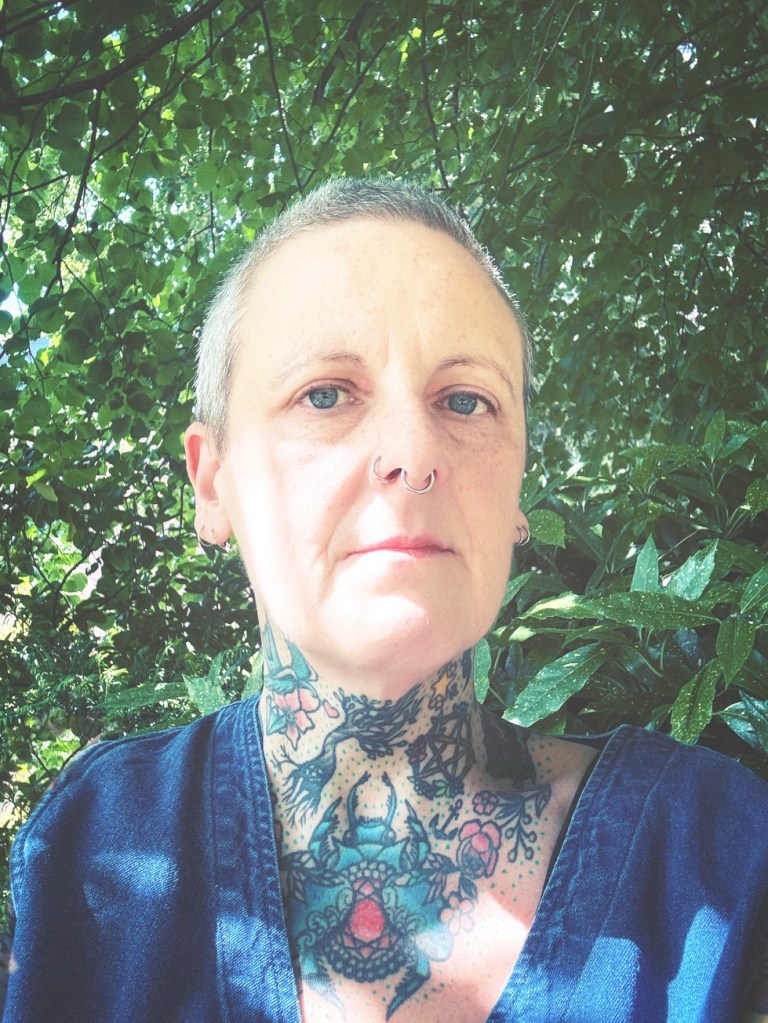
Dr Clare Lesley Hughes is a Spiritual Ecologist and Wortcunner, and the founder of Herbal Hegemone, a holistic space offering plant-based complementary care and ecospiritual mindfulness practices. Her first PhD, in Biology, was awarded by the University of York and she is currently undertaking a second PhD in Humanities, Religion, and Philosophy at York St John University, exploring the Enchanted and Marginalised Worlds of Wortcunners in Britain. Alongside her research, she is deeply engaged in the wider academic and spiritual community, contributing through editorial and organisational roles that foster interdisciplinary dialogue and collaboration. A pagan and critical ecofeminist, Clare brings a deeply rooted love of nature to all aspects of her work and life.
 Terra Two